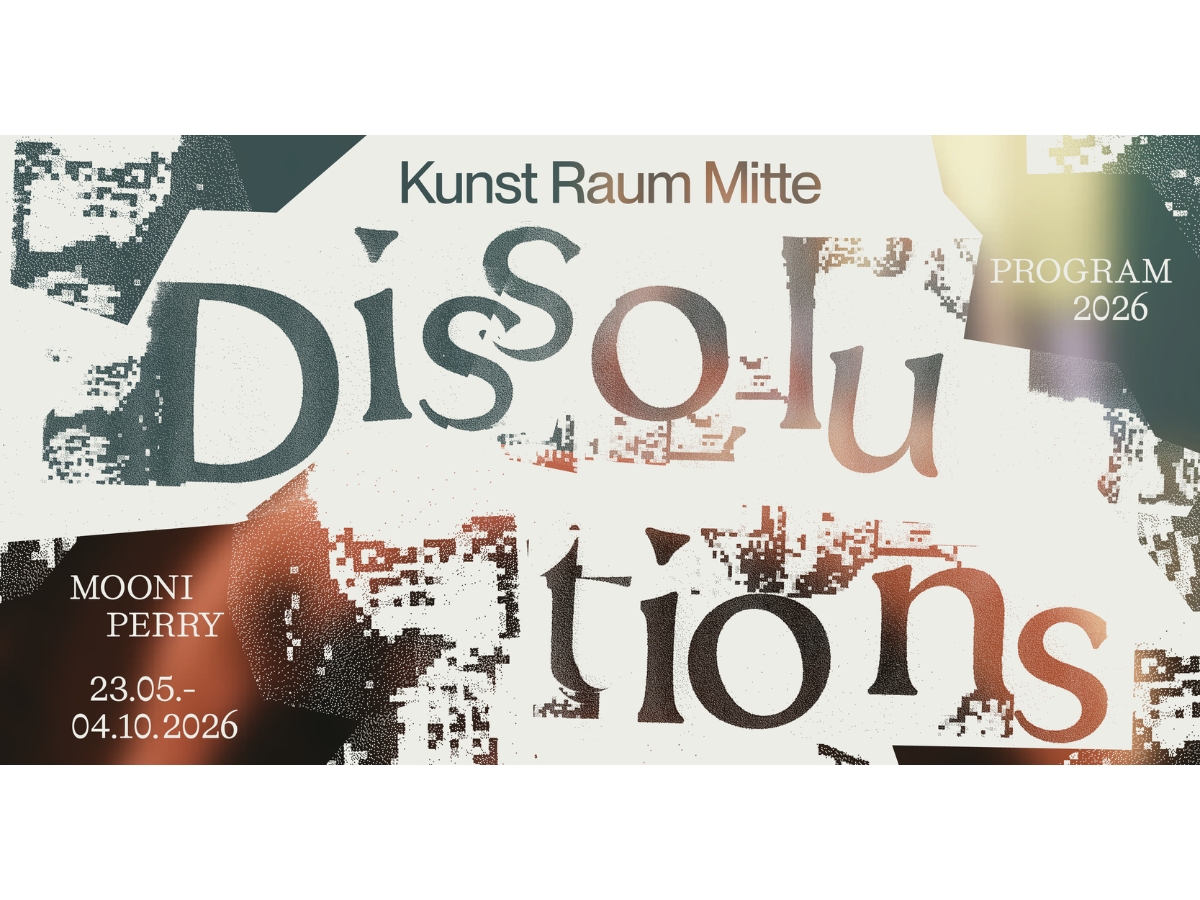
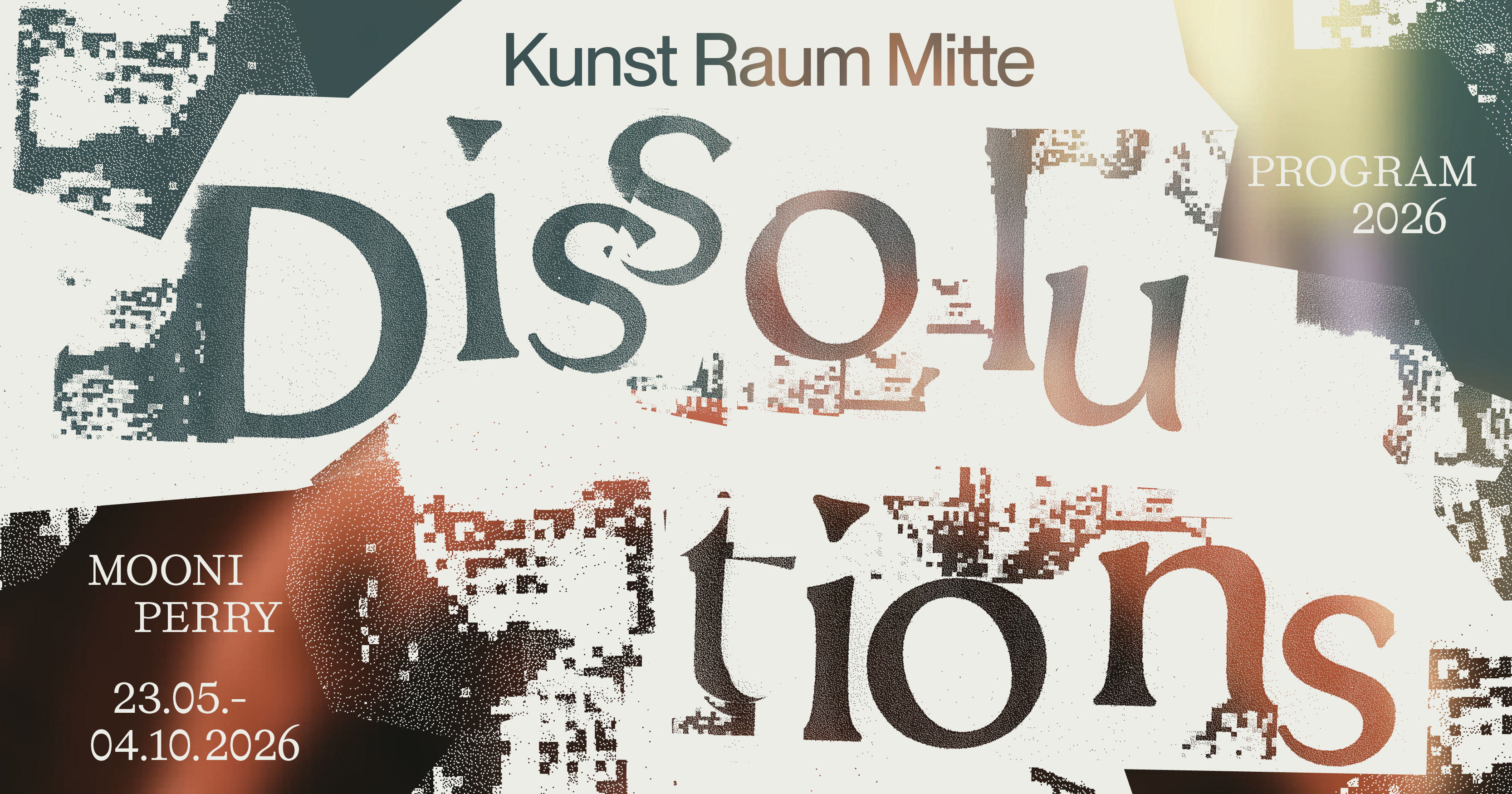
23 May – 4 October 2026
Mooni Perry, Montika Kham-on, Luzie Meyer, Hanwen Zhang
Exhibition & Events
DISSOLUTIONS Sequence II
23 May – 4 October 2026
Opening 22 May 2026, 6 – 9 PM
The second sequence of the annual program DISSOLUTIONS begins on May 22 with a solo exhibition by artist and filmmaker Mooni Perry. For the first time, the video installation EL (2025) will be presented in Europe. Inspired by feminist and speculative readings of East Asian history, the exhibition is accompanied by a program of events including a screening featuring works by Montika Kham-on and Hanwen Zhang, the open reading group Haunted Potentials, and a performative reading by Luzie Meyer.
The video installation EL (2025) forms the core of Mooni Perry’s solo exhibition at Kunst Raum Mitte. In her work, Perry combines music, collective research, and cinematic staging. The exhibition takes as its premise the historical and cultural entanglements of East Asia in the context of Japanese colonial rule in Korea and Northeast China. Between 1932 and 1945, this region was under Japanese control as the state of Manchukuo. It was promoted as a space of new possibilities, driven by migration and promises of the future. However, as the history of the so-called ‘comfort women’—women forced into sexual slavery by the Japanese military during the war—shows, this vision was based on coercion, repression, and human trafficking.
EL is based on this spatio-temporal constellation. At its center is the former Yamato Hotel in Shenyang in northeastern China, in what was once Manchukuo. Staged as a utopian, exotic “new world,” the video narrates an encounter between a Korean poet and a Chinese opera singer. Their interaction triggers a chain of dreamlike sequences and reflections in which one’s sense of place is questioned, and the ruins of the past are traversed, making traces of local history perceptible in an uncanny way. Atmospherically, the video unfolds as music and historical documents come together.
At Kunst Raum Mitte, this interest in site-specific historiographies shifts into the institutional framework itself: the historic building—originally built as part of a school complex in the German Empire, used as an after-school care center in the GDR, and taken over by municipal cultural programs after reunification—becomes readable as a layered site that carries within it diverse historical and political contexts and is transformed into a fictional in-between world. Archival materials from Kunst Raum Mitte enter into spatial proximity with historical documents from Perry’s work, rendering the boundaries between local and East Asian histories porous. Which historical dimensions remain invisible in a place, how are they narrated, who remembers them, and through what means are they brought to life?
Mooni Perry approaches these questions of tradition and Korean identity through an artistic practice that combines speculative fiction, feminist perspectives, and collective research. In resonance with her work, a curated selection of archival materials from galerie weisser elefant is on display. In this sequence, a spatial installation reflects fleeting moments of traversing and hosting. Since its renaming as Kunst Raum Mitte in 2024, the program curated by Natalie Keppler and Agnieszka Roguski has examined the institutional history of the municipal gallery, reorganizing it and linking it to previously overlooked contexts as well as to contemporary art.
The exhibition is part of the second sequence of the DISSOLUTIONS program, which explores processes of dissolving and reformulating narratives. The sequence includes a series of events with Montika Kham-on, Luzie Meyer, and Hanwen Zhang, as well as the reading group Haunted Potentials.
Mooni Perry engages with diasporic spirituality and East Asian deities, gendered cosmologies, and evolving forms of ritual in East Asia and beyond. She is a co-founder of the Asian Feminist Studio for Art and Research (AFSAR), a platform for collective research and artistic practice. Her work has been exhibited at institutions including CHAT (Centre for Heritage, Arts and Textile), Hong Kong; the Bangkok Art Hall;the National Museum of Modern and Contemporary Art, Seoul; Westfälischer Kunstverein, Münster; KW Institute for Contemporary Art, Berlin; Neuer Berliner Kunstverein, Berlin; Kai Art Center, Tallinn; and ARKO Art Center, Seoul.
Exhibition curator: Agnieszka Roguski
Program curators: Natalie Keppler and Agnieszka Roguski
Curator Haunted Potentials: Annika Reketat
DISSOLUTIONS
Mooni Perry
23.5. – 4.10.2026
22.5.2026
6 PM Opening
26.6.2026 – 28.6.2026 Screening: Montika Kham-on, Hanwen Zhang
26.6.2026
5 PM Reading Group Haunted Potentials (registration required)
7 PM Screening: Montika Kham-on, Hanwen Zhang
8 PM Talk: Montika Kham-on, AFSAR / Mooni Perry, Hanwen Zhang
2.7.2026
7 PM Performative reading by Luzie Meyer
17.7.2026
5 PM Reading Group Haunted Potentials (registration required)
24.7.2026
6 PM Exhibition tour Agnieszka Roguski, curator of the exhibition
DISSOLUTIONS Sequence II
23 May – 4 October 2026
Opening 22 May 2026, 6 – 9 PM
The second sequence of the annual program DISSOLUTIONS begins on May 22 with a solo exhibition by artist and filmmaker Mooni Perry. For the first time, the video installation EL (2025) will be presented in Europe. Inspired by feminist and speculative readings of East Asian history, the exhibition is accompanied by a program of events including a screening featuring works by Montika Kham-on and Hanwen Zhang, the open reading group Haunted Potentials, and a performative reading by Luzie Meyer.
The video installation EL (2025) forms the core of Mooni Perry’s solo exhibition at Kunst Raum Mitte. In her work, Perry combines music, collective research, and cinematic staging. The exhibition takes as its premise the historical and cultural entanglements of East Asia in the context of Japanese colonial rule in Korea and Northeast China. Between 1932 and 1945, this region was under Japanese control as the state of Manchukuo. It was promoted as a space of new possibilities, driven by migration and promises of the future. However, as the history of the so-called ‘comfort women’—women forced into sexual slavery by the Japanese military during the war—shows, this vision was based on coercion, repression, and human trafficking.
EL is based on this spatio-temporal constellation. At its center is the former Yamato Hotel in Shenyang in northeastern China, in what was once Manchukuo. Staged as a utopian, exotic “new world,” the video narrates an encounter between a Korean poet and a Chinese opera singer. Their interaction triggers a chain of dreamlike sequences and reflections in which one’s sense of place is questioned, and the ruins of the past are traversed, making traces of local history perceptible in an uncanny way. Atmospherically, the video unfolds as music and historical documents come together.
At Kunst Raum Mitte, this interest in site-specific historiographies shifts into the institutional framework itself: the historic building—originally built as part of a school complex in the German Empire, used as an after-school care center in the GDR, and taken over by municipal cultural programs after reunification—becomes readable as a layered site that carries within it diverse historical and political contexts and is transformed into a fictional in-between world. Archival materials from Kunst Raum Mitte enter into spatial proximity with historical documents from Perry’s work, rendering the boundaries between local and East Asian histories porous. Which historical dimensions remain invisible in a place, how are they narrated, who remembers them, and through what means are they brought to life?
Mooni Perry approaches these questions of tradition and Korean identity through an artistic practice that combines speculative fiction, feminist perspectives, and collective research. In resonance with her work, a curated selection of archival materials from galerie weisser elefant is on display. In this sequence, a spatial installation reflects fleeting moments of traversing and hosting. Since its renaming as Kunst Raum Mitte in 2024, the program curated by Natalie Keppler and Agnieszka Roguski has examined the institutional history of the municipal gallery, reorganizing it and linking it to previously overlooked contexts as well as to contemporary art.
The exhibition is part of the second sequence of the DISSOLUTIONS program, which explores processes of dissolving and reformulating narratives. The sequence includes a series of events with Montika Kham-on, Luzie Meyer, and Hanwen Zhang, as well as the reading group Haunted Potentials.
Mooni Perry engages with diasporic spirituality and East Asian deities, gendered cosmologies, and evolving forms of ritual in East Asia and beyond. She is a co-founder of the Asian Feminist Studio for Art and Research (AFSAR), a platform for collective research and artistic practice. Her work has been exhibited at institutions including CHAT (Centre for Heritage, Arts and Textile), Hong Kong; the Bangkok Art Hall;the National Museum of Modern and Contemporary Art, Seoul; Westfälischer Kunstverein, Münster; KW Institute for Contemporary Art, Berlin; Neuer Berliner Kunstverein, Berlin; Kai Art Center, Tallinn; and ARKO Art Center, Seoul.
Exhibition curator: Agnieszka Roguski
Program curators: Natalie Keppler and Agnieszka Roguski
Curator Haunted Potentials: Annika Reketat
DISSOLUTIONS
Mooni Perry
23.5. – 4.10.2026
22.5.2026
6 PM Opening
26.6.2026 – 28.6.2026 Screening: Montika Kham-on, Hanwen Zhang
26.6.2026
5 PM Reading Group Haunted Potentials (registration required)
7 PM Screening: Montika Kham-on, Hanwen Zhang
8 PM Talk: Montika Kham-on, AFSAR / Mooni Perry, Hanwen Zhang
2.7.2026
7 PM Performative reading by Luzie Meyer
17.7.2026
5 PM Reading Group Haunted Potentials (registration required)
24.7.2026
6 PM Exhibition tour Agnieszka Roguski, curator of the exhibition