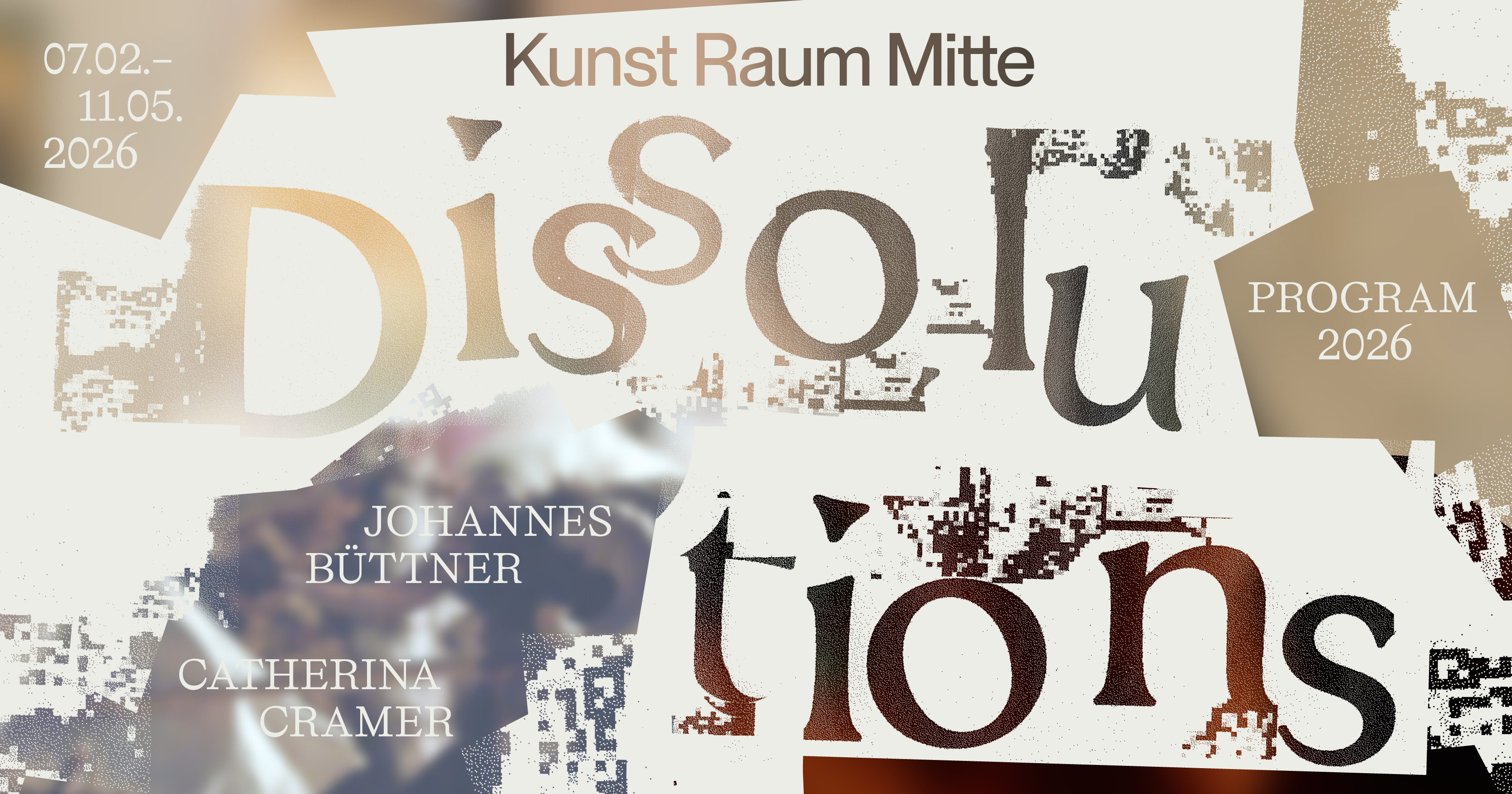
DISSOLUTIONS Sequence I
7 February – 10 May 2026
Opening 6 February 2026, 6 – 9 PM
DISSOLUTIONS uses the principle of dissolution and evaporation to counter rampant capitalism and the solidification of power imbalances. As a result, the artists in the annual program do not show attempts at rescue, but rather demonstrate the decisive disintegration of existing conditions—as well as the afflictions, fantasies, and ideas of past and future times. This gives rise to changing constellations of installation, performance, video, and conversation; repetition and interruption determine the rhythm of the program.
The first sequence of the annual program is a duo exhibition by Catherina Cramer and Johannes Büttner , whose expansive worlds move between the real abysmal nature of neoliberal exploitation—which is currently particularly noticeable due to cultural policy austerity measures—and the imaginations of possible counterworlds.
Continuously placing the exhibition venue’s archive material in new contexts since 2024, the material now reveals its own transience of use, sorting, and disorder—thus exposing apparent trivialities.
Curated by Natalie Keppler & Agnieszka Roguski
Events:
27.02.2026
6 PM Guided tour with Johannes Büttner and Natalie Keppler
10.4.2026
6 PM Guided tour with Agnieszka Roguski
7 PM Concert / soundtrack of the film Do Not Go Gentle Into That Good Night by Catherina Cramer & Sabine Bremer
About the Works
Catherina Cramer
Indexical, 2026
Installation, index-works (found objects on linen), soft
sculpture, light
Catherina Cramer’s installations are worlds full of allusions and references; images, text, and sculpture intertwine. At the center of these scenarios,—somewhere between film, comic, and science fiction thriller—is the human body, which is absent as such. Cramer examines it as a carrier and embodiment of disease. In doing so, she does not explore medical norms, but rather the narratives to which they are subject. Her almost criminological approach is based on set pieces from various foundobjects, text fragments, and materials, and unfolds as a search for clues rather than a linear narrative. Migraine and chronic fatigue syndrome form the culmination point: Cramer shows how these conditions are categorized as diseases and how they measure the performance of bodies. To illustrate the dimensions of this body politics, Cramer emphasizes the fictions and stories that supposedly claim control. These are thwarted by the
visible seams and tears that—scratched and glued—reveal the inscriptions of illness on bodies. Tangible fantasies that seemingly cannot or do not want to fill the installation appear here as a gigantic, perhaps sleeping, perhaps collapsed teddy bear on which visitors can sit to view the wall-based works. These fantasies tell of something shiny and new that, precisely in theirfragmentary nature, form a coherent whole. Illness is thus transformed from an individual deficiency into a social fact, in which deviations are integrated just as much as vulnerabilities and humor. The exhausted body, it can be concluded, is not a personal deficit, but instead reveals its possibilities for care in a dark yet luminous way—resisting the neoliberal imperative of omnipresent performance and the binary division into healthy or sick forms of existence.
Johannes Büttner
L’ État, c’ est moi, 2025/26
Video installation (45 min.), computer program, microwaves, plaster casts, wall cabinets, clocks, clock holders, wood relief
How to get through, 1995/2025
Video installation (30 min. video loop), airplane seats, headphones, Euro-pallet, pins from the anti-racist initiative “Die Gelbe Hand”, wood, PVC flooring
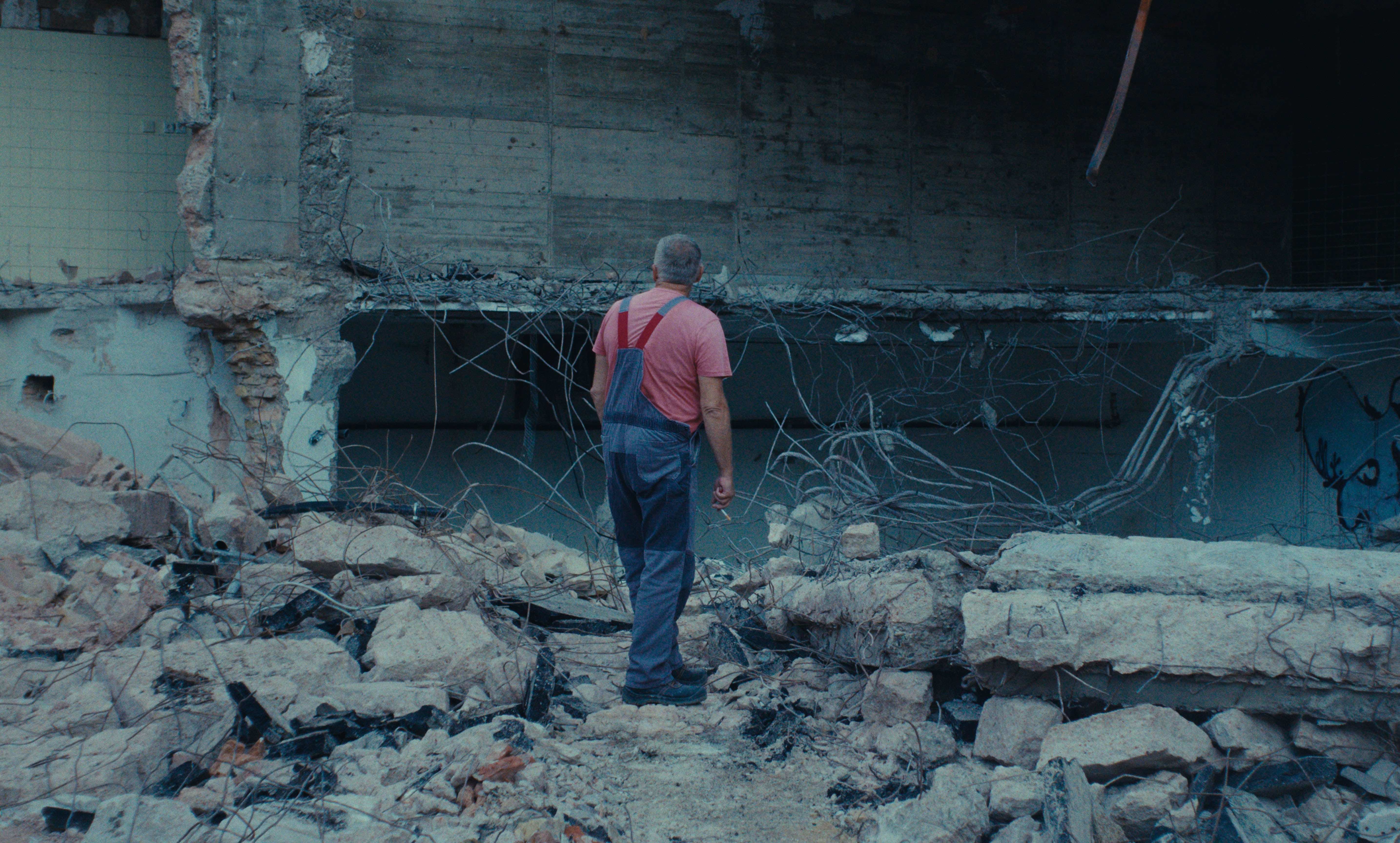
Buzzing microwaves pile up in the Kunst Raum Mitte to form a city of apparatuses, accelerating the time between progress and decay. In the video work L’État, c’est moi (Engl.: “The state is me”), Johannes Büttner explores the founding of the anarcho-capitalist pseudo-state of the so-called “Free Republic of Liberland,” which exists both geographically—on a piece of no man’s land between Serbia and Croatia—and digitally in the metaverse. The stark contrast between a futuristic luxury world designed by the architectural studio Zaha Hadid and a swampy forest area becomes increasingly apparent in the video. By superimposing a computer game level over the documentary footage, and through Büttner’s encounters with characters ranging from authoritarian-libertarian to racist, reality and fiction oscillate: irrationality and delusion become painfully clear. What appears to be a promise for the future ultimately seems like a relapse into tech feudalism.
In 1995, the group Keine Verbindung e.V. cut data cables in the Frankfurt Airport information network and temporarily crippled the system with this analog cyberattack—as a protest against racist policies and the Federal Republic’s deportation practices, which were concentrated in specially designated “deportation zones” at the airport. Afterwards, a video by the group circulated under the title How to get through, serving as both a manifesto and a guide to the attack. Büttner brings this story from subcultural memory into the present and reveals how, almost thirty years later, these practices are once again enforced through policies of isolation and deportation, as part of the normalization of racist violence. By focusing on so-called special administrative zones—also in connection with L’État c’est moi—How to get through makes the arbitrariness of state action and national sovereignty particularly clear. Büttner ultimately hands over the manifesto video to the Frankfurt Airport archive, thereby not only commemorating history, but also inscribing it into the system as a disruption. The place of deportation becomes the place of recollection itself.